
Condition Vigilance: The common root of better outcome and better CMI
By Scott Cullen, MD, Chief Medical Officer
In a previous post we shared findings from our analysis of 118 major academic medical centers: hospitals in the top 20% for condition coding had 10% lower-than-expected mortality, and 63% of that gap came from actual reductions in death — not from inflated expected rates. The data was clear. What we didn't fully explore was why. (1)
So why do top-coding organizations experience fewer than expected deaths? And what separates hospitals that do it well from those that don't? I believe it is all about condition vigilance.
What happens when a condition goes unrecognized
Most unexpected inpatient deaths don't result from a single catastrophic event. Similar to calamities in aviation, engineering, and finance, many mortality episodes result from a cascade of clinical deteriorations that, individually, were manageable but collectively became unsurvivable. A patient admitted for pneumonia develops acute kidney injury on day two. That goes unrecognized for 36 hours. By the time it's caught, the patient is fluid-overloaded, cardiac function is compromised, and the clinical team is managing a crisis that didn't need to happen. (2)
This pattern repeats across conditions. Malnutrition that slows wound healing and weakens immune response. Electrolyte disorders that trigger arrhythmias. Coagulation abnormalities that turn a routine procedure into post-operative hemorrhage. These aren't rare diagnoses — they're among the most common inpatient complications coded. The difference between hospitals isn't whether these conditions occur. It's whether they're caught early enough to rescue.
The Mechanism: Recognition creates a treatment window
When we looked more closely at the group of institutions in the high-performance range on both coding and outcomes, a consistent factor emerged. Hospitals with the strongest outcomes weren't doing anything exotic. They were identifying evolving conditions sooner — often 12 to 24 hours earlier than their peers.
Hospitals that perform well on both these metrics share several characteristics:
They are devoting more resources to concurrent clinical documentation review.
Concurrent reviewers are coordinated or even integrated into clinical care delivery teams
Condition recognition is a clinical quality initiative, not a coding exercise.
Concurrent vs. retrospective review is the single biggest structural factor driving better results. The literature consistently shows that programs reviewing charts during the stay, querying within 24 hours of admission, and following up every other day, outperform retrospective programs. (3) The hospitals in our top 20% aren't doing better retrospective reviews. They're recognizing conditions at the point of care, in real time, while there's still an opportunity to intervene.
What's next?
The logical next question is this: What is the impact of predictive visibility into evolving conditions? Our expanding Predictive Diagnostic Discovery work with several leading academic medical centers using a subset of HDAI's 1,100 predictive models is beginning to tell us as noted in ACDIS’s annual report. (4, 5,6,7)
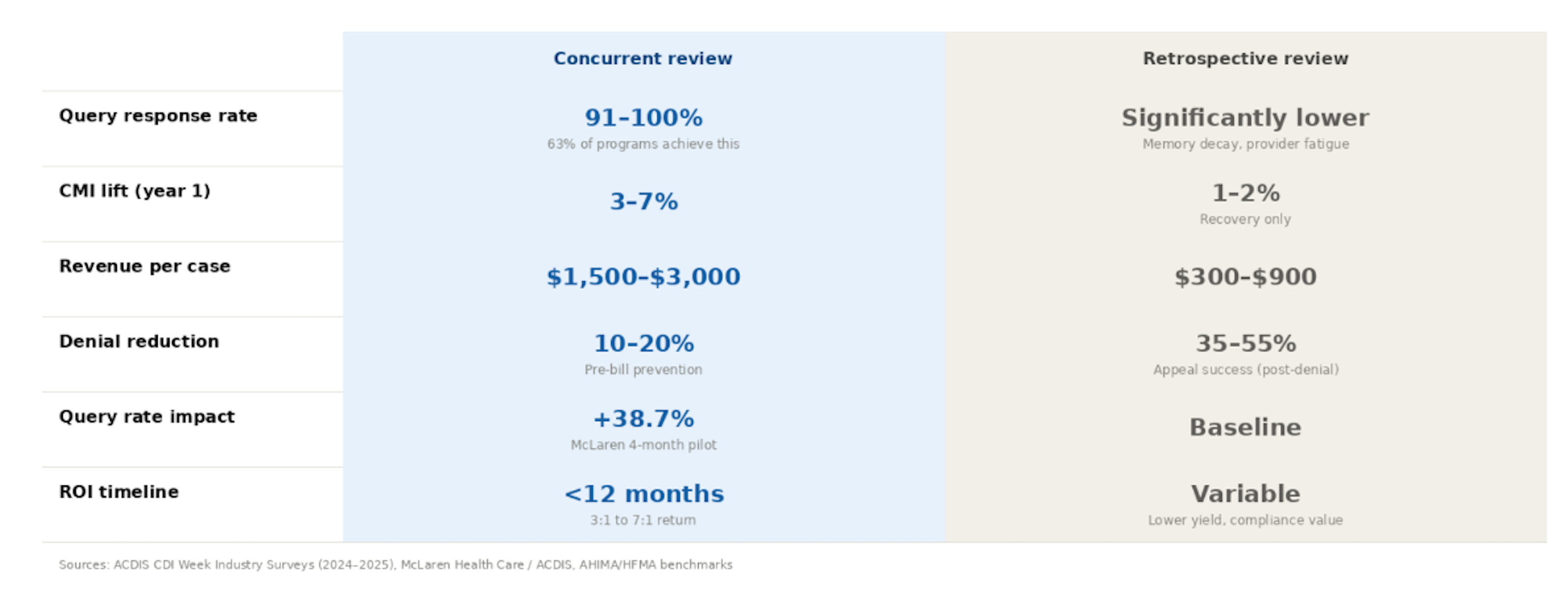
Figure: Concurrent vs. retrospective CDI review — industry benchmarks
When models flag conditions predictively within the first few hours of admission, and continuously throughout the stay, the entire care team is aware early enough to act, and clinical documentation can once again become a byproduct of the clinical work, not the seeming goal of it. A hospital that catches acute kidney injury 18 hours earlier helps the patient but also documents a more complete clinical picture. The revenue follows the recognition.
We call this Condition Vigilance, the systematic, proactive identification of conditions that are evolving in your patients right now and, if recognized and managed, could potentially change the care trajectory as well as code capture.
At HDAI we use Predictive Diagnostic Discovery tools, embedded in the EHR, to consistently surface new CC/MCC coding opportunities on 3-5% of base DRG cases in the pre-bill phase. As predictively driven concurrent review grows, our partners could realize the same level of clinical and coding performance that the top 20% of major institutions are realizing while using fewer resources and greater coverage of admitted patients. (8)
Health Data Analytics Institute (HDAI) provides predictive analytics and clinical intelligence solutions to hospitals and health systems nationwide. For more on our Predictive Diagnostic Discovery tools, see our earlier post or reach out directly.
References
(1) Health Data Analytics Institute. Analysis of 118 major academic medical centers using CMS Inpatient Quality Reporting data, 2019–2023.
(2) Reason J, 1990. Human Error. Cambridge University Press. See also Dekker S, 2011. Drift into Failure. Ashgate.
(3) ACDIS CDI Week Industry Survey, 2025. 62.75% of respondents reported a 91%–100% physician query response rate for concurrent review programs. Association of Clinical Documentation Integrity Specialists (ACDIS/HCPro).
(4) MacPhee S. "Shifting Gears: The Value of Concurrent CDI Audits." Presented at ACDIS Conference, 2023. McLaren Health Care, Grand Blanc, MI. CDI query rate increased 38.7% during 4-month concurrent review pilot; 54% of concurrent audits resulted in a DRG change without a query.
(5) ACDIS CDI Week Industry Survey, 2024. Concurrent CDI programs drive CMI increases of 3%–7% within the first year vs. 1%–2% for retrospective recovery. See also AHIMA/HFMA revenue integrity benchmarks.
(6) HFMA Revenue Integrity Analysis. Concurrent review programs improve revenue per case by $1,500–$3,000 in high-acuity service lines vs. $300–$900 for retrospective audits.
(7) CMS and OIG audit findings; multiple health systems report 10%–20% denial reduction after implementing concurrent CDI reviews. Payer dispute benchmarking studies report appeal success rates of 35%–55%.
(8) Health Data Analytics Institute internal data, 2025–2026. CC/MCC coding opportunities identified on 3–5% of base DRG cases in pre-bill phase across current partner institutions.
Share this